Hypothesis

TMRE 2026 · Denver

The State of Research & AI

A look inside the TMRE mind

We spent three days with the leaders and practitioners of our industry at TMRE in Denver, having conversations, collecting perspectives, and moderating a panel of leaders from HP, Microsoft, and Peloton. We combined what we heard on stage with nearly 200 survey answers gathered throughout the event to identify the themes that felt most important, surprising, and consequential for where insights is headed next.

Respondents
Brand & supplier side
Questions
Fielded, 2026
Oct 5–6

The takeaways

Four themes from TMRE 2026

What we heard from the people at our booth and the insights leaders on our panel.

  1. Theme 01From keepers of knowledge to catalysts for decisionsRead it
  2. Theme 02AI is making research faster. So why are researchers so exhausted?Read it
  3. Theme 03In-person, human-led research is having a renaissance in this age of AI-powered researchRead it
  4. Theme 04The next breakthrough in insights may be leveraging what we already knowRead it
Theme 01

From keepers of knowledge to catalysts for decisions

Democratization isn’t diminishing the role of insights; it’s expanding its influence. As AI gives more people access to customer knowledge, insights professionals are evolving from the gatekeepers of research into the experts who help organizations turn that knowledge into better decisions. This shift was evident in our conversations at TMRE, where respondents repeatedly identified a need for more actionable recommendations, stronger strategic guidance, and a clearer connection between research and business outcomes. As one respondent put it, “We need to be consultants influencing business decisions and most of that has nothing to do with methodological expertise.” The value of insights is increasingly measured not by the research produced, but by the decisions it enables.

A clear recommendation, not options.
TMRE attendee
It’s getting both more diversified and more focused. Researchers need to know so much and become embedded everywhere.
TMRE attendee

This was echoed by panelists from HP and Peloton, who described how democratizing research has freed their teams to focus on more complex strategic questions and engage earlier in decision-making. But this expanded influence comes with expanded expectations. Researchers are being asked to know more, move faster, and influence across more parts of the business. The opportunity is enormous: a more customer-centric organization, powered by insights expertise that reaches further than ever before. The challenge is ensuring insights teams have the skills, confidence, and capacity to deliver on that promise. Across TMRE, we also heard clients describe the emerging role of insights as an orchestrator or guide: helping stakeholders who now have direct access to data ask better questions, interpret what they are seeing, and connect customer knowledge across functions that once operated in silos.
Theme 02

AI is making research faster. So why are researchers so exhausted?

AI promises unprecedented efficiency, but that efficiency isn’t necessarily translating into breathing room. It’s unlocking research that previously wasn’t feasible, while raising expectations for how quickly insights should be delivered. Speed and AI adoption were recurring themes in our TMRE survey, with 25 of 32 respondents explicitly referencing AI or automation when asked what was changing their work most. Several also pointed to shorter timelines, resource constraints, and growing pressure to do more with less. Microsoft’s panelist captured the paradox: the ability to conduct research in a fraction of the time doesn’t necessarily mean less work. Instead, it can mean more requests, more decisions about what to prioritize, and more research that wouldn’t have been commissioned before. That makes prioritization a core capability: when AI expands what is possible, insights teams have to become more deliberate, even ruthless, about which questions they answer.

Inspired and worried and overwhelmed.
TMRE attendee
Uncertain about the current priority of faster and more, versus better.
TMRE attendee · Brand side

The emotional toll of that transformation was equally evident. TMRE respondents described feeling excited, curious, hopeful, uncertain, nervous, and overwhelmed—sometimes all at once. They also raised concerns about job security, the pace of upskilling, and how the next generation of researchers will develop foundational skills when AI increasingly handles the groundwork. The panelists acknowledged the same tensions within their teams, emphasizing the importance of shared learning, vulnerability, and recognizing that people adapt at different speeds. The next challenge for insights leaders may be less about accelerating AI adoption and more about making that acceleration sustainable. The organizations that thrive won’t necessarily be those that move fastest, but those that help their people keep up without burning out.

Theme 03

In-person, human-led research is having a renaissance in this age of AI-powered research

In an industry racing to automate everything, something unexpected is happening: the desire for old-school, human-to-human research is growing. AI can simulate consumers, synthesize thousands of conversations, and uncover patterns at unprecedented speed. But as these capabilities become ubiquitous, the things AI can’t replicate become increasingly valuable. Our TMRE survey revealed a clear distinction between the tasks researchers are eager to automate and the human connection, empathy, and judgment they’re determined to preserve. Rather than signaling the end of traditional research, AI may be making the case for getting closer to real people than ever before.

Real respondents. I’m not here for synthetic data for our audiences.
TMRE attendee
More and faster and cheaper with AI, but human oversight and judgment are more important than ever to tease out what’s real and meaningful vs. slop.
TMRE attendee · Supplier side

This tension came to life on our panel, where HP described a renewed appetite for ethnographic research, including a recent study observing consumers struggling to set up printers in their homes. Watching real frustration unfold was powerful enough to make senior engineering leaders visibly uncomfortable—an impact no AI-generated summary could quite replicate. Peloton similarly emphasized the enduring importance of human-led lab research and ethnography, even as AI becomes embedded in its workflows. The irony is that the more AI can tell us about consumers, the more valuable it becomes to experience their reality firsthand. And with AI accelerating so much of the research process, insights teams may finally have more opportunity to invest in the deeply human experiences that make insights impossible to ignore.

Theme 04

The next breakthrough in insights may be leveraging what we already know

Organizations have spent years accumulating customer knowledge, yet much of that intelligence remains buried in past projects, presentations, and disconnected data sources. AI-enabled knowledge management is beginning to change that equation, making existing research more accessible and actionable. At TMRE, respondents called for better synthesis across research projects, a single source of truth, and, perhaps most importantly, “Data at the moment decisions are being discussed.” The message is clear: businesses don’t necessarily need more data. They need better ways to access, connect, and apply the knowledge they already have, at the moment it matters.

Actionable insights. There’s so much data, it can be overwhelming.
TMRE attendee
More connection across disciplines.
TMRE attendee · Brand side

In our panel, HP and Peloton described how AI-powered research repositories are enabling their teams to rapidly draw on years of existing research, contribute to strategic conversations earlier, and identify where genuine knowledge gaps remain. This represents a fundamental shift from research as a series of standalone projects to an always-on intelligence capability. Historical knowledge provides context, while fresh primary research fills gaps, tests assumptions, and keeps insights grounded in today’s consumers. The opportunity is to get smarter about what existing evidence can be trusted and reused, what needs updating, and when the right answer is to go back to real people.

On stage at TMRE

From the Panel

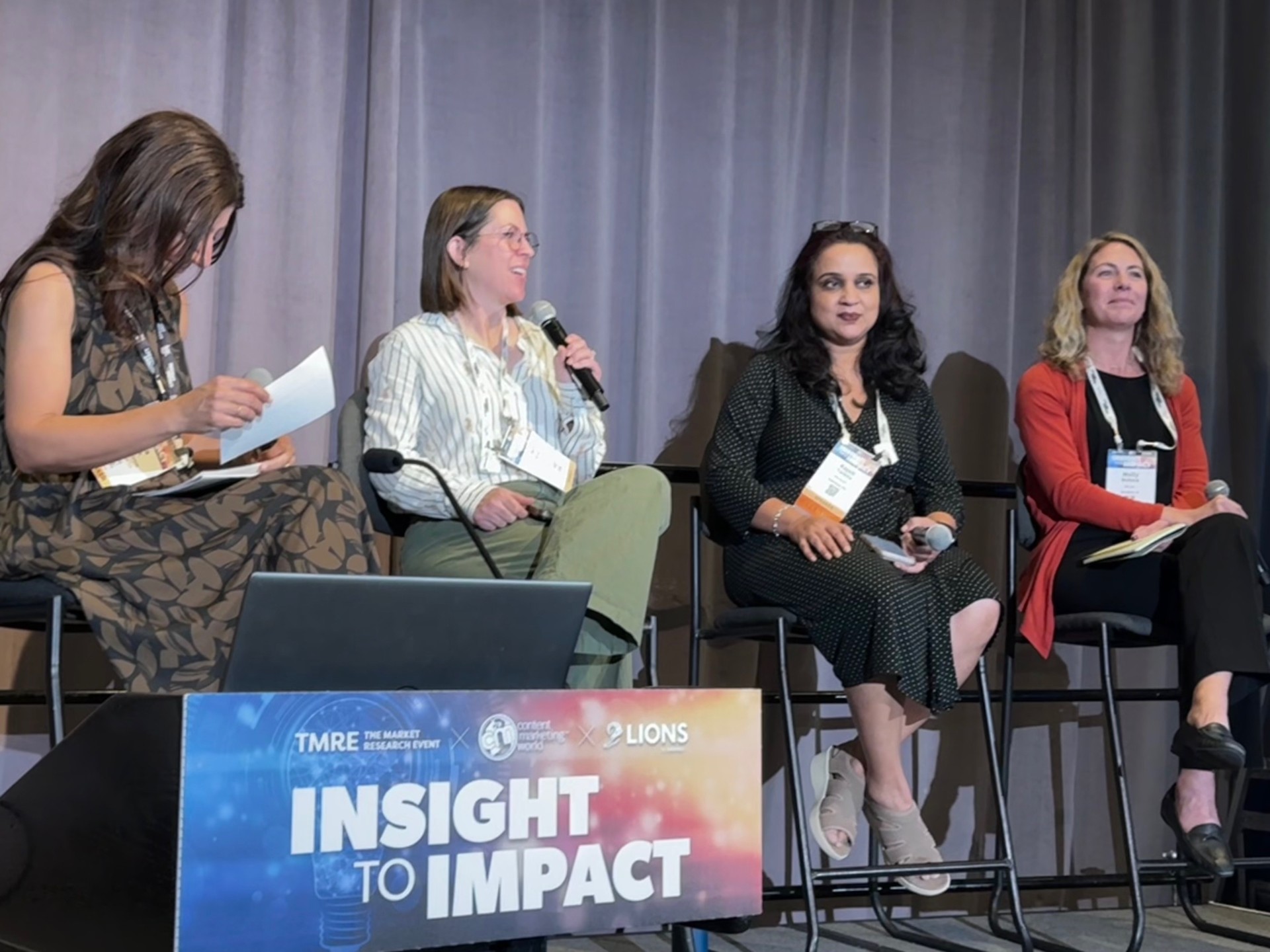
Our panel brought together insights leaders from HP, Microsoft and Peloton to talk about what AI is changing for their teams.

Our moderator and panel of insights leaders on stage at TMRE 2026
  • “I tell my team a lot that we are influencers. That’s our job. We’re not decision makers at Peloton. We’re not the blocking function. We influence decision makers.”
    Laura RiveraPeloton
  • “While we’re transforming so many of the stages, it’s not that the customer touchpoints are reducing at all. In fact, I feel like our deep qualitative is deeper than ever before because it is AI-enhanced.”
    Kajoli TankhaMicrosoft
  • “It’s not who has the most tools; it’s who makes the ones that they have matter the most.”
    Molly BullockHP

From the panel discussion.

Explore

Explore every answer

Pick a question, then click a theme to read the answers behind it.

Themes

Click on a theme to explore further

Hover an icon to read that person’s answer. Some answers fit more than one theme, so a person can appear under more than one.

About this survey

How this was made

Where and when

Fielded at TMRE 2026, Colorado Convention Center, Denver, October 5–6, 2026. People answered on iPads at the Hypothesis booth, and their answers appeared live on the wall.

Who answered

The six questions

    How we sorted the answers

    We read every answer and grouped similar ones into themes by hand. Some answers fit more than one theme, so the same person can be counted under more than one. We fixed typos and tidied punctuation without changing what anyone meant.

    Privacy

    No names or companies are shown.